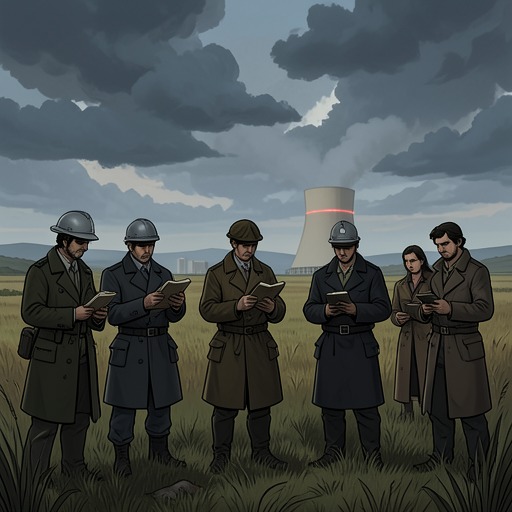
War of all wars
Voices from Chernobyl“War of all wars” is a phrase used to make the scale and nature of Chernobyl graspable without reducing it to an ordinary military conflict. Its decisive claim is that this war has no safe rear: radiation reaches beyond the places where people might expect to shelter, while the disaster continues through displacement, contamination, and the altered lives of those associated with it.
An enemy without a refuge
The most explicit formulation is: “Chernobyl is like the war of all wars. There’s nowhere to hide. Not underground, not underwater, not in the air.” The sentence takes the familiar logic of wartime refuge and turns it inside out. A bunker, the water, even the air cannot promise escape. The threat is not presented as an advancing army that can be seen and evaded, but as something that makes the ordinary distinction between a safe place and a dangerous one collapse.
A second speaker compresses the comparison into a declaration: “Here we have the war of wars—Chernobyl.” Around that line, images of ordinary rural life sit beside the impossibility of controlling what has changed. Birds call and wildlife enters gardens; people may be resettled, but animals cannot be moved in the same way, and water travels beneath borders. The war metaphor therefore extends beyond human plans and political boundaries. Its reach is environmental as well as personal, and its consequences cannot be contained by simply leaving a place.
The measure of earlier wars
For one speaker, Chernobyl is understood against memories of the Second World War. The family had lost seventeen people; the speaker’s mother had wept for those dead, and an old woman offered a consoling interpretation of sacrifice. The speaker, a teacher who had taught children that good would triumph, says they could do anything for the Motherland except kill. That inherited moral vocabulary gives the new disaster a frame, but also exposes its difference: the speaker describes Chernobyl as a war with no underground shelter.
The contrast is not that previous suffering was small. It is that wartime dangers could be imagined through familiar acts of violence and survival, while this catastrophe resists those categories. The phrase “war of all wars” enlarges the comparison until it points to a danger that cannot be fought by the usual means or escaped by retreat. The unease is sharpened by the speaker’s account of life after the disaster: there is little news, people live quietly, and visitors bring rumors of upheaval elsewhere. That fragile quiet does not undo the catastrophe; it sits inside a world the speakers can no longer fully understand.
A war carried into everyday life
The expression also resonates with accounts of people being made into outsiders after evacuation. One former resident describes the transformation from an ordinary person with a job, salary, and annual vacation into a “Chernobyl person,” someone stared at and questioned as though they were an object of curiosity. In Minsk, evacuees paid triple the usual price for train seats; a conductor gave tea to others but asked them for their cups after learning where they came from. The war did not end at the edge of the contaminated area: its mark followed people into ordinary exchanges.
That mark could shape intimate choices. A young woman from a Chernobyl family, already registered to marry her fiancé, says she fears that others will regard having children as sinful. She calls people like herself the “Chernobyl Hibakusha,” connecting her uncertain future to survivors of Hiroshima. The analogy makes visible a further consequence of the war metaphor: contamination becomes social suspicion, and the possibility of love and family is made to feel dangerous.
Children, too, bear that suspicion. After a family settles in Mogilev, a boy returns from his first day at school in tears; a classmate refuses to sit beside him because he is radioactive, and the other children call him “Shiny.” The phrase “war of all wars” gathers such distinct losses without making them identical: no refuge from radiation, no straightforward return home, and no guarantee that displacement will restore ordinary life. Its force lies in naming a catastrophe whose battlefront enters bodies, homes, memory, and the relationships people hoped would continue.